 Under the Haik
Digital Books: What Do We Really Own?
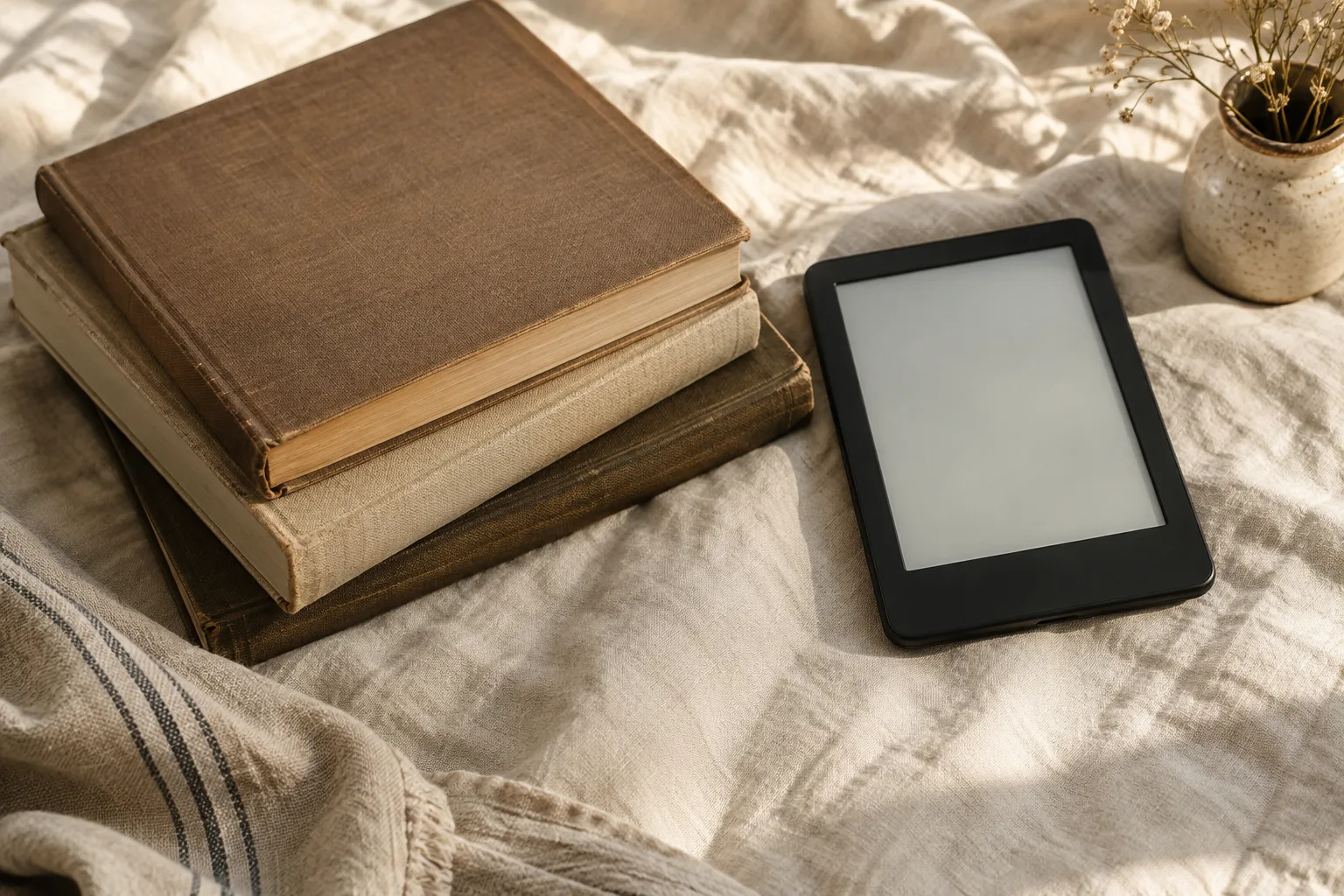
Save the Planet, Don’t Print Books: Here Is Your E-Reader
We have been told for years that the future of books is digital. Printing consumes paper, paper comes from trees, physical books take up space, and transporting them around the world has an environmental cost. So why not put everything on a small electronic device instead? Thousands of books in your pocket, instantly accessible, searchable, synchronized to the cloud. It sounds like an obvious improvement.
But there is something we rarely question when we make this transition: what exactly are we giving up when we stop owning the physical book?
A physical book is a remarkably simple thing. Once you buy it, it exists independently of the company that published it. If the publisher changes the text ten years later, your copy does not change. If the company disappears, your copy remains. If the internet goes down, it remains. You can lend it, sell it, give it to your children, or leave it untouched on a shelf for a hundred years. Most importantly, the words cannot be silently replaced.
Digital books are different. When you buy a book through a platform such as Kindle, what you have is not simply an object sitting in your home. Your access exists within an ecosystem of accounts, software, licensing, servers and corporate infrastructure. That is extremely convenient, but it also creates a dependency that physical books never had.
Now imagine something that may sound paranoid: you buy a digital book today, read it, and remember a particular passage. Ten years later, you open the same book and the passage is different. Perhaps a sentence has been removed, a historical detail changed, or a controversial section rewritten. You remember the old version, but when you search for it, you cannot find it anywhere. The current edition says that it has always been this way.
How would you prove otherwise?
This is where the question becomes more interesting than the usual arguments about technology. Human memory is unreliable, and people can certainly misremember things. But if the original digital version has disappeared and nobody kept an independent copy, we have created a situation where it becomes impossible to distinguish between a false memory and a changed record. The problem isn’t necessarily that someone will change the book. The problem is that, if someone ever wanted to, the disappearance of physical copies could make it much harder to prove what the original actually said.
And this becomes even more important as artificial intelligence changes the way we consume information. Companies have enormous incentives to collect books, articles, research and other forms of human knowledge to train AI systems. Imagine a future in which vast libraries have been digitized, processed and absorbed into corporate AI systems, while physical books gradually become less common because digital copies are cheaper and more convenient. What happens if those companies eventually become not only the distributors of knowledge, but some of its primary custodians?
The danger isn’t necessarily a secret conspiracy in which someone sits in a room deciding which sentence to rewrite. Power does not always work that deliberately. It can be much more ordinary: a company acquires another company, a platform changes its policies, an edition is replaced, an archive is removed, a database is corrected, an unpopular work becomes unavailable, or an AI system repeatedly presents one version of an event until that version becomes the only one most people ever encounter.
The more centralized the system becomes, the more important independent copies become.
There is an irony here. The internet has given us more copies of information than humanity has ever had before, but those copies are not necessarily independent. A million people accessing the same digital database are still ultimately depending on the same source. If that source changes, a million people can receive the changed version. By contrast, a hundred physical copies of an old book scattered across different libraries, countries and private homes provide something much more valuable for historians: independent witnesses that can be compared against one another.
We should therefore be careful about confusing access with ownership. Having access to ten thousand books through an e-reader is extraordinary, but it is not the same as having ten thousand physical objects that exist independently of the company providing them. Digital technology has solved the problem of scarcity remarkably well. The question is whether, in doing so, we are creating a new problem of dependence.
This is not an argument against e-readers, nor is it an argument that every company is secretly rewriting history. It is an argument for skepticism about centralized control over knowledge. Companies change. Governments change. Institutions change. The people who control today’s platforms will not necessarily be the people who control them fifty years from now. A civilization should not have to trust whoever happens to hold that power at any given moment.
So perhaps the answer isn’t to reject digital books, but to keep something alongside them. Use the e-reader. Store books digitally. Enjoy the convenience. But for important works, keep physical copies too. Keep old editions. Keep them in libraries, universities and private homes. Make sure that no single company, platform or server becomes the only surviving witness to what a book once contained.
We are often told, “Save the planet. Don’t print books.” Perhaps we should reduce unnecessary printing. But we should also ask another question: save the planet for whom, and preserve its knowledge under whose control?
Because one day, if the last physical copies disappear and the only remaining version of a book exists in a system controlled by someone else, we may discover that we didn’t really preserve the book at all.
We preserved access to the version that someone is willing to let us see.
And those are two very different things.